Wisdom Teeth Can Make Other Dental Problems More Complicated
Posted 8/21/2026 in Oral Surgery

Wisdom teeth do not always cause problems right away. In some cases, they can remain in the jaw for years without obvious symptoms. But as wisdom teeth and their roots fully develop, their position can affect nearby teeth and make future dental treatment more complicated.
Dr. John Wessel, a board-certified oral and maxillofacial surgeon in Rock Hill, SC, treated a 39-year-old patient whose impacted lower wisdom tooth complicated what was initially expected to be a routine molar extraction.
The patient had gone to her general dentist to have a lower second molar removed. After a difficult attempt, her dentist recognized that the extraction required a surgical approach and referred her to Dr. Wessel. Imaging at his office revealed an important part of the problem: an angled wisdom tooth directly behind the molar was essentially locking the tooth in place.
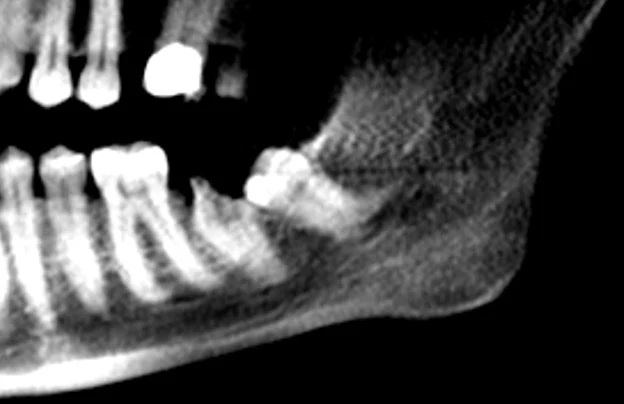
*Imaging shows the impacted wisdom tooth blocking access to the second molar
The case is a good example of why evaluating wisdom teeth earlier during the teenage years or early adulthood can help prevent more complicated problems later.
How Can a Wisdom Tooth Affect the Molar in Front of It?
Wisdom teeth, also called third molars, develop behind the second molars at the very back of the mouth. When there is not enough room for them to erupt normally, they may remain partially or completely impacted beneath the gums.
In this patient’s case, the wisdom tooth was positioned at approximately a 60-degree angle toward the second molar. Over time, its position created significant pressure against the tooth in front of it.
Dr. Wessel explains, “Once the gum tissue was lifted, it was much more obvious how the wisdom tooth was locking in the molar in front of it. Removing the wisdom tooth first immediately gave us the access we needed to remove the second molar.”
Importance of 3D CBCT Imaging
The position of the teeth was only part of the concern. Both the wisdom tooth and second molar had fully developed roots that appeared very close to the inferior alveolar nerve, a nerve that runs through the lower jaw and provides sensation to the lower teeth, lip, and chin.
Unlike a traditional two-dimensional dental x-ray, a CBCT scan allows an oral surgeon to examine the teeth, roots, surrounding bone, and nearby anatomical structures from multiple angles. In a case where tooth roots are close to a nerve, that additional information can be important for surgical planning.
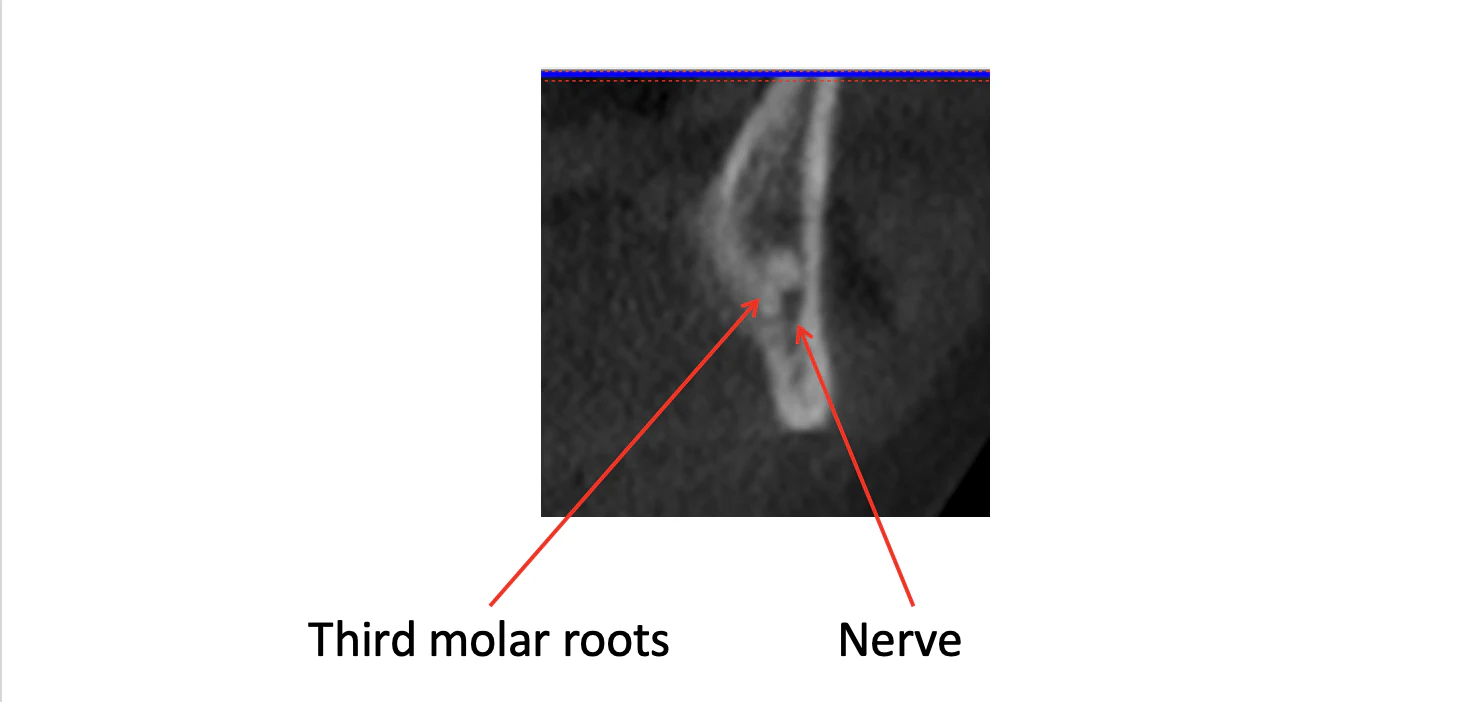
*Imaging shows the nerve between the root and bone
“Going in with a plan and having advanced imaging is really important,” Dr. Wessel says. “We can see where the nerve is relative to the roots and plan how we section and remove the tooth to minimize the amount of pressure being transferred to that area.”
Using the CBCT scan as a guide, Dr. Wessel surgically divided the wisdom tooth into smaller sections and removed them individually. Once the wisdom tooth was out, he was able to remove the second molar.
Why Are Wisdom Teeth Often Easier to Remove When You’re Younger?
Wisdom teeth typically continue developing through the teenage years and into early adulthood. As a person gets older, the roots become longer and more formed.
For lower wisdom teeth, those developing roots may also cause problems with the nerve running through the jaw. This is one reason oral surgeons often recommend evaluating wisdom teeth before they are fully developed rather than waiting until they become painful or cause another dental problem.
Dr. Wessel explains, “That’s one of the reasons we like to remove wisdom teeth in the teenage years. The roots are not fully formed yet. They’re much shorter, and there is often more separation between the tooth roots and the nerve.”
Age alone does not determine whether wisdom teeth should be removed. Their position, available space, development, symptoms, surrounding teeth, and overall oral health all play a role. An early evaluation gives an oral surgeon the opportunity to monitor these factors and recommend treatment when appropriate.
What Happens When Wisdom Teeth Are Left Untreated?
Not every impacted wisdom tooth will cause a problem, but waiting until symptoms develop can sometimes mean treating a more complicated situation.
For this patient, what began as a planned molar extraction turned into an urgent referral to an oral surgeon, additional imaging, IV sedation, and surgical removal of both the wisdom tooth and second molar.
The case also involved a more significant discussion about nerve-related risks because the roots of the teeth were already fully developed and located close to the nerve.
“If we could roll back time and the wisdom tooth had been removed when she was younger, this likely would have been a much simpler situation,” Dr. Wessel says. “The procedure can be easier, recovery can be easier, and there may be less risk when the roots are not fully developed.”
When Should Wisdom Teeth Be Evaluated?
Many patients have their wisdom teeth evaluated in their late teens, between the ages of 16 and 25, even if they aren’t experiencing pain. An evaluation does not automatically mean the teeth need to be removed. It allows an oral surgeon to determine how the teeth are developing and whether their position could create problems in the future.
A wisdom teeth evaluation with Dr. Wessel in Rock Hill can help address these concerns even before pain or other symptoms have developed.
A wisdom teeth evaluation may be particularly helpful if:
- Your dentist or orthodontist notices an impacted or angled wisdom tooth.
- There is limited space behind the second molars.
- You experience pain, swelling, or tenderness toward the back of your mouth.
- A wisdom tooth appears to be contacting or affecting a neighboring molar.
- You are in your teens or early twenties and have never had your wisdom teeth evaluated.
Early Evaluation Can Help Prevent a More Complicated Problem
This case highlights an important point about wisdom teeth removal: the best time to evaluate wisdom teeth is often before they create an urgent problem.
As Dr. Wessel’s patient experienced, a wisdom tooth that has been quiet for years can still become an important factor when another dental issue develops nearby.
If you or your teenager still have wisdom teeth, an evaluation with an oral and maxillofacial surgeon can help determine their position, stage of development, and whether removal may be recommended.
Schedule an appointment with Dr. John Wessel for a wisdom teeth removal evaluation in Rock Hill, or with one of our oral surgeons in any of our centers across the Carolinas, to learn more about your treatment options.




Related Blogs

Oral Surgery

Oral Surgery

Oral Surgery
Why Impacted Wisdom Teeth Shouldn't Be Ignored
April 20, 2026

Oral Surgery