“One of the more common questions I get is, when is the best time to remove wisdom teeth and why? The short answer is roughly age 15 to 18.”
— Dr. John Wessel, oral and maxillofacial surgeon, Rock Hill, SC
Families across Charlotte, Rock Hill, and the surrounding area often ask when to get wisdom teeth removed, especially when nothing hurts yet. Below, Dr. Wessel explains why the mid-to-late teen years are usually the best time, why earlier isn’t always better, and when to ask your dentist for a referral.
What Age Should You Get Your Wisdom Teeth Removed?
For most patients, Dr. Wessel recommends ages 15 to 18 because three things tend to line up during these years:
The roots are about two-thirds formed. The tooth has developed enough to remove easily, but the most irregular part of the root hasn’t formed yet.
The tooth has moved closer to the surface. As a wisdom tooth develops, it pushes up toward the top of the jawbone and may start coming through the gums. A tooth that is closer to the surface is easier and safer to remove.
Teens heal well. According to Dr. Wessel, patients in this age group have “a very robust healing capacity.”
“If we take out the wisdom teeth 15 to 18, it’s the lowest risk,” Dr. Wessel says.
Wisdom Teeth Removal Age Chart
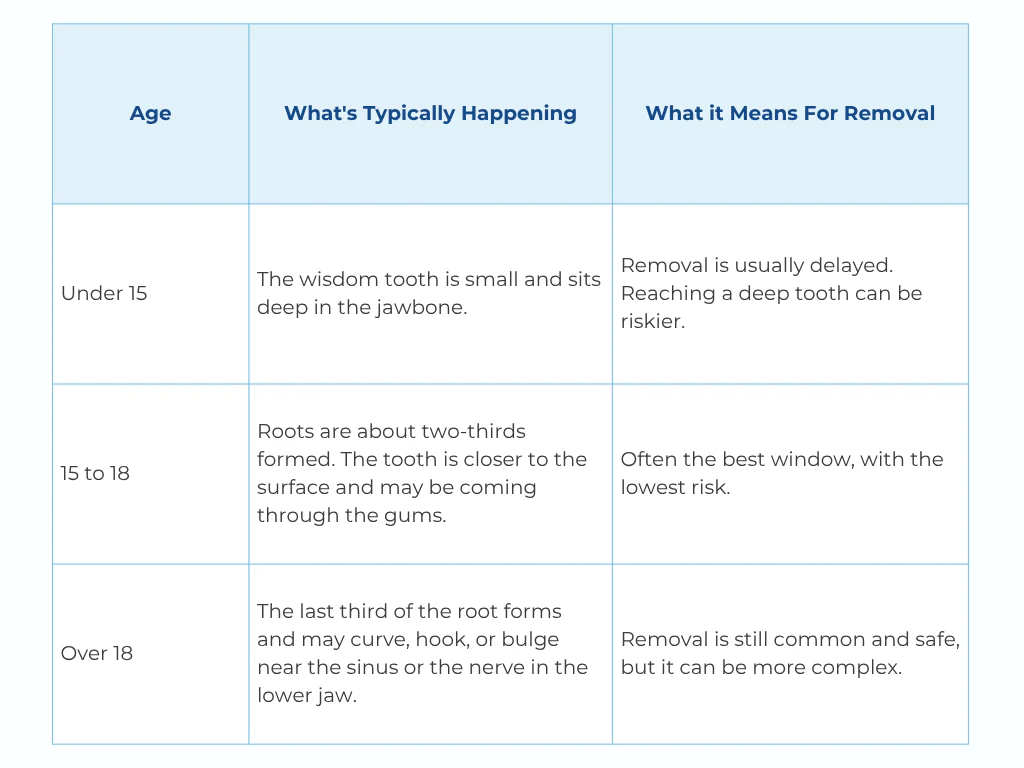
Every patient develops on their own timeline. An X-ray shows where your teen’s wisdom teeth are in this process.
Why Wisdom Teeth Roots Matter
The timing of wisdom teeth removal comes down mostly to the roots.
“The last one-third of the wisdom tooth root is where all of the risk comes from,” Dr. Wessel explains. “The last one-third tends to be very irregular. That’s what wisdom teeth are known for. They form hooks and curves and kind of bulbous roots.”
As those final root sections grow, they can extend toward important nearby structures:
- Upper wisdom teeth can grow close to the sinus cavity.
- Lower wisdom teeth can grow close to the nerve in the lower jaw (the inferior alveolar nerve), which provides feeling to the lower lip, chin, and gums.
Removing a wisdom tooth before the last third of the root forms can help avoid some of that complexity. The American Association of Oral and Maxillofacial Surgeons (AAOMS) notes the same pattern: wisdom teeth are easier to remove in younger patients because the roots aren’t completely formed and there is less chance of damaging nearby nerves.
What’s the Youngest Age to Get Wisdom Teeth Removed?
If shorter roots make removal easier, why not take wisdom teeth out at 12 or 13?
Because timing matters in both directions. “Much earlier than 15, the wisdom tooth tends to be very small and kind of deeper in the jawbone, where it’s more risky to remove,” Dr. Wessel says. “So we typically delay until 15 to 18.”
The goal is to wait until the tooth is developed enough to reach easily, but not so long that the roots become irregular or grow near the sinus or nerve.
What Age Do Wisdom Teeth Come In?
Wisdom teeth usually come in between ages 17 and 25, according to AAOMS. They start forming years earlier, though, and a dentist can often see them developing on X-rays before they come through the gums. That’s why the best time to have them evaluated is usually before they appear.
Is It Too Late to Remove Wisdom Teeth After 18?
No. Wisdom teeth are removed safely in adults of all ages. But as the roots finish forming, removal can become more involved, and recovery may take a little longer.
Waiting can also let problems develop without symptoms. In one Rock Hill case, Dr. Wessel treated a patient whose impacted wisdom tooth damaged the molar next to it, and the patient never felt pain. Read more in When Waiting Too Long to Remove Wisdom Teeth Leads to Bigger Problems.
Do Wisdom Teeth Have to Be Removed if They Don’t Hurt?
Not always, but a lack of pain doesn’t mean a wisdom tooth is healthy. Some impacted wisdom teeth stay painless while pressing on neighboring teeth or growing toward the nerve or sinus. Others are well positioned and can be monitored.
The decision should be based on an exam and X-rays rather than symptoms. Waiting for wisdom teeth to hurt often means waiting past the best window. For more, see Why Are Wisdom Teeth Removed? Risks of Leaving Them In.
Why the Teen Years Make Recovery Easier
Root development isn’t the only reason the teen years work well. Dr. Wessel also points to the support teens have at home: “You’re under your parents’ watchful care. They help manage your prescriptions. They help with meal preparation.”
Planning ahead also lets families schedule surgery around school breaks, sports seasons, and activities instead of reacting to a sudden problem later. For a day-by-day look at healing, see our wisdom teeth removal recovery timeline.
How to Know if Your Teen’s Wisdom Teeth Are Ready to Come Out
The first step usually happens at a regular dental or orthodontic visit. Dr. Wessel recommends:
- Talk with your dentist or orthodontist. Ask them to look at your teen’s wisdom teeth on an X-ray.
- Check the roots. If the roots are about two-thirds formed, or they’re getting close to the sinus or nerve, it’s time for the next step.
- Ask for a referral to an oral surgeon. An oral and maxillofacial surgeon can do a full evaluation and recommend removal or monitoring.
During the consultation, the oral surgeon will look at:
- How far each tooth and its roots have developed
- Whether the teeth are impacted or starting to come through the gums
- The angle and position of each tooth
- How much room there is in the jaw
- How close the lower wisdom teeth are to the nerve
- How close the upper wisdom teeth are to the sinus
- Whether a wisdom tooth is affecting the second molar next to it
A consultation doesn’t mean surgery right away. Sometimes the best plan is to keep monitoring.