Why Isn’t My Child’s Adult Tooth Coming In? How 3D CBCT Imaging Can Reveal Hidden Causes of an Impacted Canine
Posted 4/20/2026 in Oral Surgery

When one adult tooth comes in normally and the matching tooth on the other side does not, that asymmetry is often a sign that something is blocking the eruption path. For parents, this can look like a tooth that seems late, stuck, or completely missing, even though it is still present below the gums.
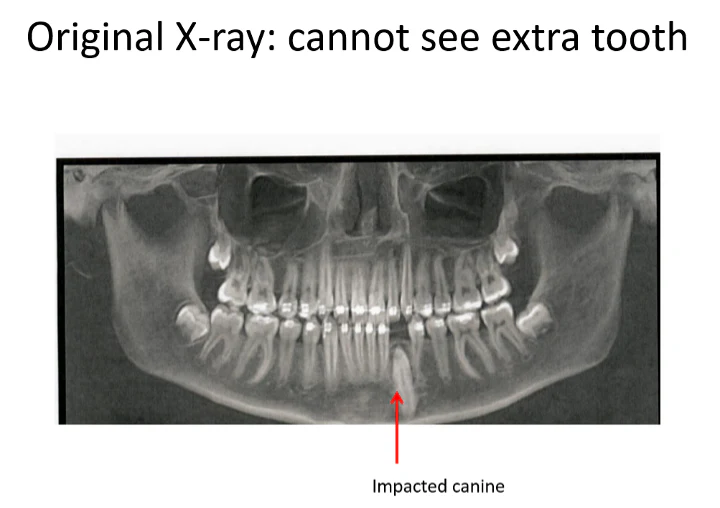
Dr. John Wessel, oral and maxillofacial surgeon in Rock Hill, SC, had a recent clinical case where advanced imaging made all the difference. A 14-year-old boy was referred to Dr. Wessel for an oral surgery consultation to evaluate a lower canine that would not erupt. On the initial orthodontic x-ray, the tooth appeared to be positioned normally, but the reason it was not coming in was still unclear.
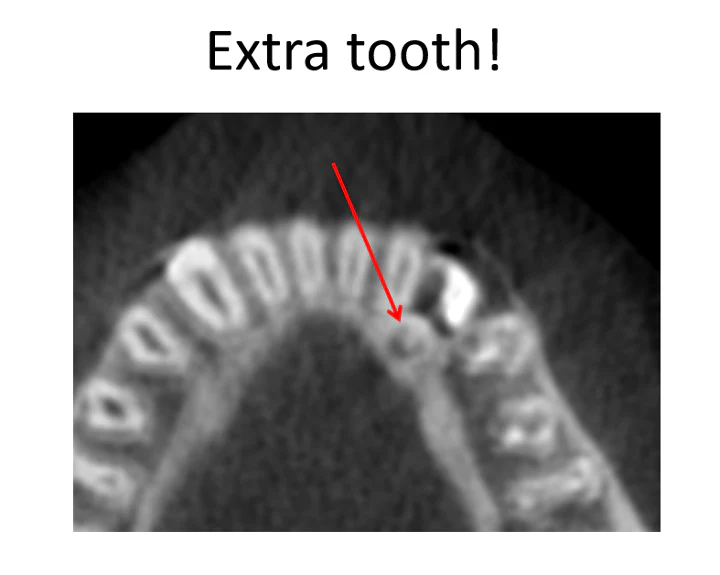
After a cone beam CT scan, the hidden cause became obvious: a very small extra tooth was sitting just behind the impacted canine. That extra tooth was blocking eruption of the adult canine tooth. That finding immediately changed the diagnosis and made it possible to move forward with a treatment plan to help the tooth erupt into a normal position.
Why Impacted Canines Happen
An impacted canine is a canine tooth that does not erupt into its normal place in the dental arch. In some cases, the cause is crowding. In others, the problem may be the position of the tooth, the angle of eruption, or a physical obstruction such as an extra tooth.
This is one reason delayed eruption should not be ignored, especially in growing patients who are already under orthodontic care. The sooner the source of the problem is identified, the easier it can be to build a treatment plan that supports the long-term health of the teeth and bite.
What 3D CBCT Imaging Can Show
Traditional two-dimensional x-rays are valuable, but they do not always show the full picture. When a tooth is hidden in bone or when a very small structure overlaps another tooth, important details can be missed.
Dr. Wessel explains, “We use advanced cone beam CT scans in our offices to allow us to see three-dimensional anatomy. These 3D x-rays show us everything, and we can look at different slices of the X-ray. It’s a little CAT scan that we take in our office that gives us all this data.”
In this case, the CBCT dental scan revealed a three-millimeter extra tooth hiding behind the lower canine, wedged near the neighboring incisor. That is exactly the type of detail that can be difficult or impossible to confirm on a standard x-ray alone.
How The Treatment Plan Changed
Once the extra tooth was identified, the treatment path for the impacted canine became much clearer. Instead of waiting and hoping the canine would erupt on its own, Dr. Wessel could remove the obstruction, perform an exposure and bonding procedure, and create a coordinated surgical-orthodontic plan.
Dr. John Wessel describes, “After removing the obstructing tooth with a small surgical procedure, we are able to access the impacted canine and bond an attachment to the tooth. We then partner with our orthodontic colleagues to bring the tooth to the surface in the dental arch slowly and safely.”
Why This Matters for Families & Referring Doctors
Without the CBCT scan, the small obstruction could have gone untreated, delaying results and creating frustration for the child, family, and the orthodontic care team.
Dr. Wessel puts it this way: “If we never removed that little extra tooth, that treatment plan would not work. The case would kind of stall out, and everybody would be frustrated and kind of scratching their head. That is why advanced imaging matters. It gives surgeons the information they need to choose a treatment plan with a higher chance of success and fewer unexpected setbacks.”
What Parents Should Watch For
Parents should consider an oral surgery evaluation if one adult tooth erupts but the matching adult tooth is not erupting, if an orthodontist sees a delayed canine, or if a child has persistent baby teeth longer than expected.
An oral surgery consultation with an oral surgeon for impacted teeth that includes CBCT imaging can help determine whether the issue is simple crowding or a hidden problem such as an impacted tooth, abnormal eruption path, or extra tooth blocking normal movement.
If your child has a tooth that is not coming in as expected, early evaluation can make treatment more predictable. Advanced imaging and a coordinated treatment plan can uncover the cause and help keep care moving in the right direction.
Schedule a consultation with one of our oral surgeons across North and South Carolina to evaluate impacted teeth, eruption problems, and other conditions that may require surgical or imaging-based diagnosis.




Related Blogs

Oral Surgery

Oral Surgery
Warning Signs of Sleep Apnea: Symptoms You Shouldn’t Ignore
April 15, 2026

Oral Surgery
TMJ Headaches: Symptoms & Treatment Options
April 1, 2026

Oral Surgery