Why Impacted Wisdom Teeth Shouldn't Be Ignored
Posted 4/20/2026 in Oral Surgery

How A Blocked Second Molar Can Affect Eruption, Braces & Oral Surgery Treatment
As a teen’s smile develops, their molars and wisdom teeth play a big role in how comfortably the upper and lower jaws fit together. When space is limited, wisdom teeth often crowd and push upon the second molars, making it harder for those teeth to erupt and line up correctly. Evaluation and treatment by a specialized oral surgeon can help.
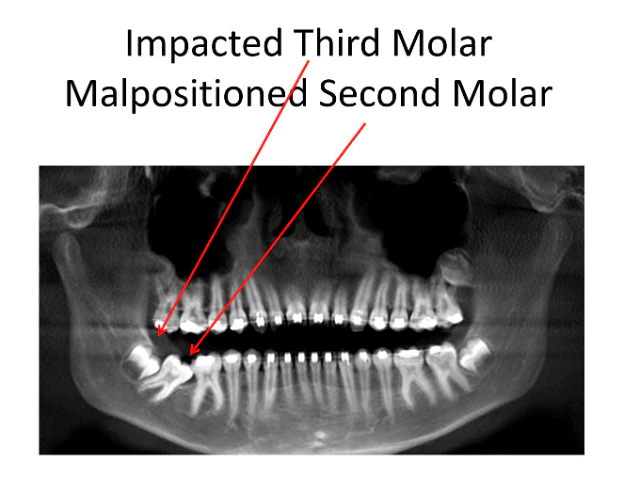
Dr. John Wessel, oral and maxillofacial surgeon at our office in Rock Hill, SC, recently had a 14-year-old patient referred by his orthodontist for impacted wisdom teeth with a lower second molar that had erupted into the wrong position.
Instead of standing upright as expected, the lower second molar was angled forward about 45 degrees and locked against the first molar. The wisdom tooth behind it was blocking the path the second molar needed in order to surface correctly in the dental arch.
Why This Matters
Second molars generally erupt around age 12. By age 14, both lower second molars are usually expected to be upright and functional, so a severely tilted or trapped tooth is a reason for an oral surgery evaluation.
When wisdom teeth block other molars from coming in or cause a tooth to grow sideways, the issue is mechanical and not just cosmetic. It can affect the health of the tooth and roots, bite development, delay orthodontic treatment, and become a more complex issue over time.
When Should My Child’s Second Molars & Wisdom Teeth Come In?
For most teens, lower second molars begin erupting around age 12, and by age 14 they are often fully in place and functioning. Wisdom teeth typically appear between the ages 16 and 25, but they may block the normal eruption path of a second molar far earlier.
If a second molar doesn’t surface by age 14, typically a dentist or orthodontist recommends evaluation by an oral and maxillofacial surgeon. Early diagnosis can determine whether the issue is crowding, abnormal angulation, or an impacted wisdom tooth that is preventing normal eruption.
How Surgery Can Create a Path for Eruption
With Dr. Wessel’s patient, the lower second molar was angled about 45 degrees into the back of the first molar, and that tooth was somewhat locked in by the wisdom tooth.
Dr. Wessel explains, “In this case, the first step was to remove the wisdom teeth or third molars. That procedure was completed in the office under sedation to keep the patient comfortable, and we removed all impacted third molars in one visit. Once the third molar was removed, the surgical plan shifted to helping the second molar become accessible for orthodontic treatment and repositioning. Removing the obstruction created the space needed for the next stage of treatment.”
How Does an Oral Surgeon Fix a Tipped or Blocked Second Molar?
After the adjacent wisdom tooth is removed, the oral surgeon can carefully remove a limited amount of bone around the back and side of the second molar to help it move into a more favorable position.
Dr. Wessel explains, “I drill a small hole through the bone of where the third molar used to live. That hole allows me to put a stitch through the bone, so I’ve got a good suture anchor.”
That stitch is then tied to the gum tissue so the tissue can be repositioned and held down long enough for healing. This gives the orthodontist direct access to the second molar so a bracket can be placed and the tooth can be slowly and precisely rotated into alignment.
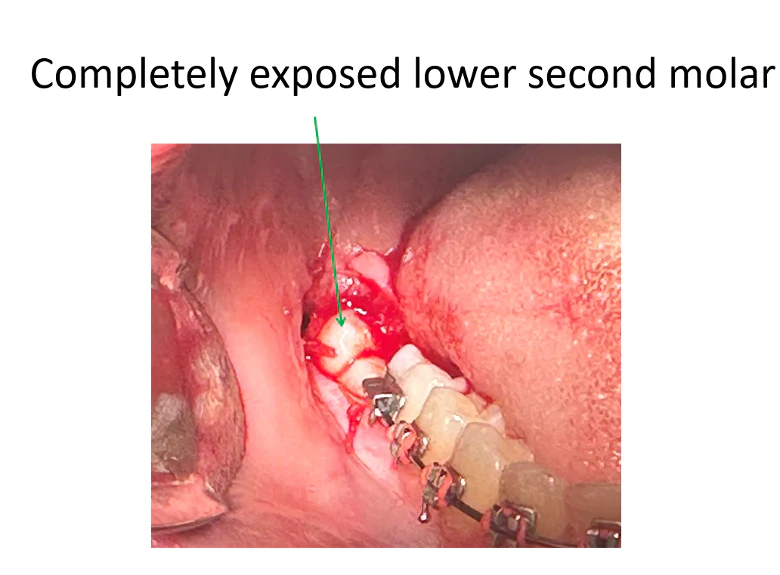
This coordinated surgical-orthodontic approach is what makes treatment efficient. Instead of waiting for a trapped molar to self-correct, the team creates a clearer path and then uses orthodontic mechanics to bring the tooth into position.
Why Referral Timing Matters
This case is a good example of why impacted wisdom teeth should be evaluated early, especially when a child or teen is already in orthodontic care. When third molars block eruption or contribute to abnormal positioning, waiting can reduce options and make treatment more complex.
Parents and orthodontists are often trying to answer the same question: should the wisdom teeth come out now, or can treatment wait? In a case like this, early evaluation by an oral surgeon helped prevent the blocked second molar from staying trapped or causing ongoing bite and alignment problems.
When to Consider an Evaluation
Parents and orthodontic patients should consider an oral surgery evaluation when a back tooth has not erupted on time, when a second molar appears tipped or trapped on an x-ray, or when impacted wisdom teeth may be affecting neighboring teeth.
A timely consultation can determine whether wisdom teeth removal alone is enough or whether a combined surgical and orthodontic approach is needed to expose and guide the tooth into the correct position.
Frequently Asked Questions About Impacted Wisdom Teeth & Second Molars
Do all impacted wisdom teeth need to be removed?
Not every wisdom tooth must be removed, but teeth that are impacted, growing at an angle, or pressing on nearby teeth are more likely to cause problems over time.
Why did my child’s orthodontist send us to an oral surgeon?
Orthodontists move teeth, but oral and maxillofacial surgeons help if surgical intervention is necessary when a tooth is trapped in bone, severely tilted, or blocked by a wisdom tooth.
Will my teen be asleep for wisdom teeth and second molar surgery?
Many teens choose sedation so they can sleep comfortably through wisdom teeth removal and any additional exposure procedure.
What happens if we wait to remove impacted wisdom teeth?
Delaying care can allow impacted wisdom teeth to interfere further with eruption, braces, and neighboring teeth.
If impacted wisdom teeth are interfering with your molars or orthodontic progress, early treatment can protect nearby teeth and create a clear path forward to oral health. Oral surgeons can diagnose the obstruction, remove impacted third molars, and work with orthodontists to improve access and alignment.
Schedule a consultation with an oral surgeon at any of our locations across the Carolinas to evaluate impacted wisdom teeth, blocked second molars, and other eruption problems that may benefit from surgical treatment and sedation.




Related Blogs

Oral Surgery

Oral Surgery
Wisdom Teeth Can Make Other Dental Problems More Complicated
August 21, 2026

Oral Surgery

Oral Surgery