Conservative Ameloblastoma Surgery: How 3D Surgical Planning Helped Preserve the Jaw
Posted 7/14/2026 in Oral Surgery

Being diagnosed with a jaw tumor can be overwhelming, especially when the recommended treatment involves removing a large section of your jawbone.
While some tumors require extensive reconstruction, advances in 3D surgical planning and patient-specific surgical guides are allowing select patients to undergo a more conservative approach without compromising treatment.
Recently, Dr. John Wessel, board-certified oral and maxillofacial surgeon at Carolinas Center for Oral & Facial Surgery in Rock Hill, SC, treated a patient with an ameloblastoma, an aggressive benign jaw tumor, using a minimally invasive, same-day surgical technique that preserved his jawbone, teeth, and nerve while successfully removing the tumor.
What Is an Ameloblastoma?
An ameloblastoma is one of the most common benign tumors that develops within the jawbone. Although it is not cancerous, it is considered locally aggressive, meaning it can continue to grow, destroy surrounding bone, and damage nearby structures if left untreated.
Because of its tendency to expand within the jaw, surgical removal is typically recommended.
The challenge is removing the tumor completely while preserving as much healthy bone and important anatomy as possible.
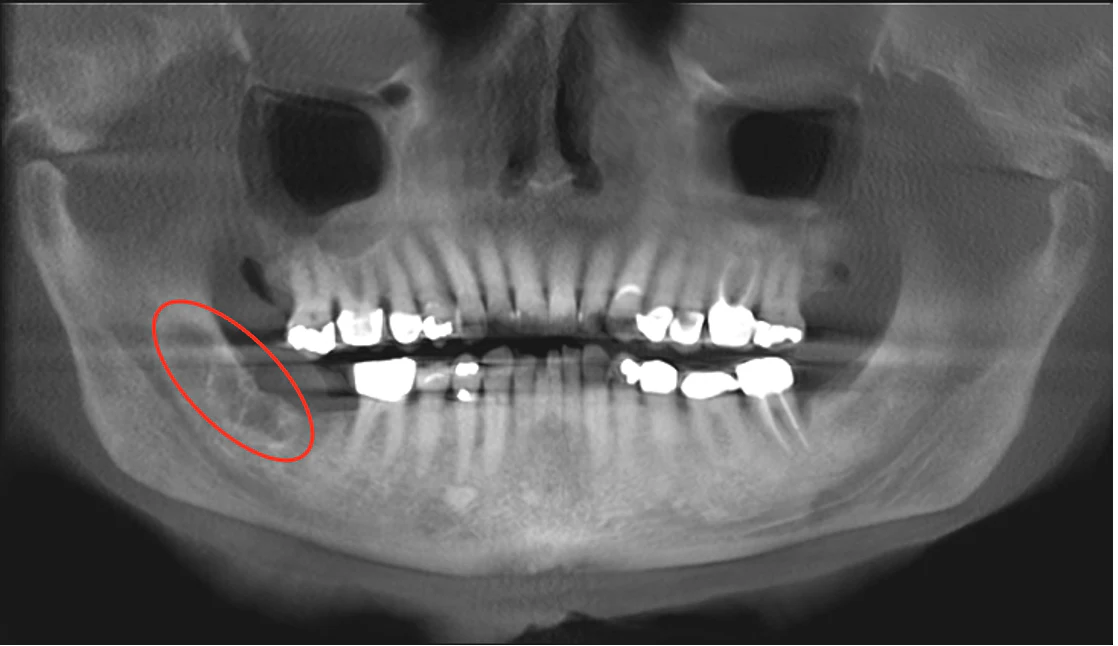
A Second Opinion Changed the Treatment Plan
An elderly patient in his 80s had previously undergone a biopsy after a suspicious area was discovered in his lower jaw while living out of state. The biopsy confirmed an ameloblastoma.
He was told treatment would likely require:
- Removal of a large portion of his lower jaw
- Reconstruction using bone from his leg (fibula free flap)
- Large plates and screws
- An incision through the neck and face
- Loss of sensation to the lower lip and chin
- A possible tracheostomy
- Two to four weeks in the hospital
For many patients, particularly older adults, this type of major surgery can involve a lengthy recovery and increased medical risks.
“For a patient in his 80s, that’s a really major surgery,” says Dr. Wessel. “You really don’t want to put someone through a long hospitalization unless it’s absolutely necessary. Bad things can happen when you’re in the hospital for that length of time.”
After relocating to South Carolina, the patient scheduled a consultation with Dr. Wessel to discuss his options.
Looking at the Tumor from a Different Perspective
Rather than immediately proceeding with a large jaw resection, Dr. Wessel carefully reviewed the patient’s imaging and took detailed measurements to determine whether a more conservative approach could safely remove the tumor.
Using advanced 3D virtual surgical planning, Dr. Wessel partnered with a medical modeling company to create a patient-specific surgical guide.
This custom 3D-printed guide fit precisely over the patient’s remaining teeth, allowing the surgical team to identify exactly where the bony cuts needed to be made before surgery even began.
The goal was simple:
- Completely remove the tumor
- Preserve the inferior alveolar nerve
- Maintain the strength of the jawbone
- Avoid unnecessary removal of healthy bone
- Eliminate the need for complex jaw reconstruction if possible
A Less Invasive Treatment Option
The procedure was performed entirely through the inside of the mouth.
There were:
- No visible facial or neck incisions
- No need for bone grafting from the leg
- No tracheostomy
- No hospitalization
During the approximately 90-minute procedure, Dr. Wessel removed the tumor with an appropriate margin of surrounding bone while preserving the nerve that provides feeling to the lower lip and chin.
The patient returned home the very same day on a soft-food diet.
![scan of patient with tumor removed]()
Pathology Confirmed Complete Tumor Removal
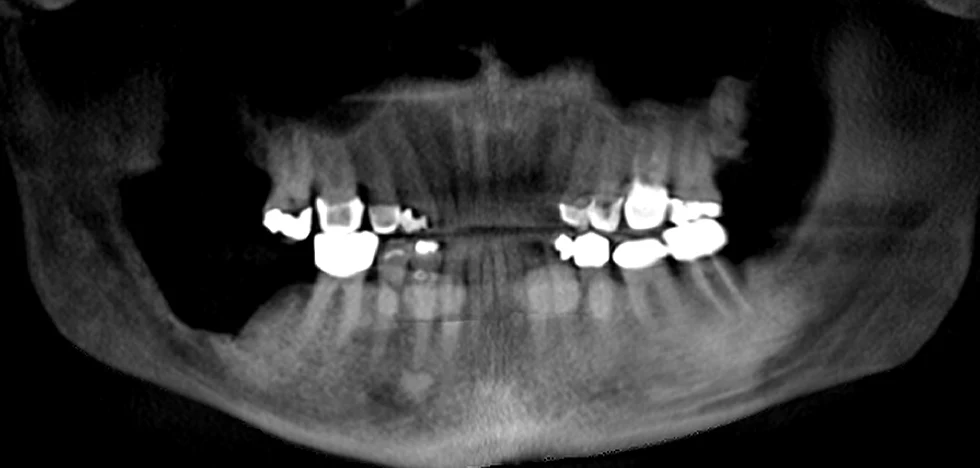
Following surgery, the tissue was sent for pathology evaluation. The pathology report confirmed negative surgical margins, meaning no tumor cells were found at the edges of the removed bone.
This indicates the ameloblastoma was successfully removed while avoiding the extensive reconstruction that had originally been recommended.
Just days after surgery, the patient reported he was recovering well with expected swelling and soreness but was otherwise doing well.
The Role of 3D Surgical Planning in Oral Surgery
One of the key factors that made this conservative approach possible was 3D virtual surgical planning.
By studying the patient’s CT scan digitally, Dr. Wessel was able to:
- Map the exact location of the tumor
- Plan precise surgical margins
- Design a custom cutting guide before surgery
- Protect important structures like the inferior alveolar nerve
- Preserve healthy jawbone whenever safely possible
This level of precision helps surgeons perform complex procedures with greater confidence while minimizing unnecessary removal of healthy tissue.
“We’re able to look at the CT scan, identify exactly where the tumor is, draw our margins around it, and then build a custom 3D-printed guide that fits over the patient’s teeth,” says Dr. Wessel. “That guide shows us exactly where we need to make our cuts so we can remove the tumor while preserving as much healthy bone and important anatomy as possible.”
When Dr. Wessel evaluates complex jaw cases in Rock Hill, this planning process can help determine whether a more conservative surgical approach is appropriate based on the location of the tumor and surrounding anatomy.
Every Jaw Tumor Requires an Individualized Treatment Plan
No two ameloblastomas are the same.
Treatment depends on several factors, including:
- The size of the tumor
- Its location within the jaw
- Whether nearby nerves or teeth are involved
- The patient’s overall health
- The risk of recurrence
Some patients require extensive jaw reconstruction, while others may be candidates for more conservative treatment.
A comprehensive evaluation by an experienced oral and maxillofacial surgeon is essential to determine the safest and most effective surgical plan.
Managing an ameloblastoma requires careful planning, surgical precision, and specialized expertise. At Carolinas Center for Oral & Facial Surgery, our board-certified oral and maxillofacial surgeons use advanced imaging, 3D surgical planning, and evidence-based techniques to treat jaw tumors with precision.
Every treatment plan is tailored to the individual patient, with a focus on achieving complete tumor removal while preserving healthy bone, important structures, and long-term function whenever possible.
An evaluation with Dr. Wessel at our Rock Hill oral surgery office can help determine an individualized treatment approach for an ameloblastoma or other complex jaw condition.
FAQs About Ameloblastoma Treatment
What is an ameloblastoma?
An ameloblastoma is a benign but locally aggressive tumor that develops in the jawbone. Although it is not cancerous, it can continue to grow, damage surrounding bone, and affect nearby teeth and nerves if left untreated.
Does every ameloblastoma require removal of the entire jaw?
No. Treatment depends on the size, location, and behavior of the tumor. Some cases require extensive jaw reconstruction, while carefully selected patients may be candidates for a more conservative surgical approach.
What does “negative margins” mean after tumor surgery?
Negative margins mean that no tumor cells were found at the edges of the tissue removed during surgery. This indicates the tumor was completely excised within the planned surgical margins.




Related Blogs

Oral Surgery

Oral Surgery

Oral Surgery
Wisdom Teeth Can Make Other Dental Problems More Complicated
August 21, 2026

Oral Surgery