Dr. Christopher Abernathy, a board-certified oral and maxillofacial surgeon at Carolinas Center for Oral & Facial Surgery in Charlotte, NC, explains the implant options for a case like this.
“I had a patient who came in from his dentist missing seven teeth, and they were all back teeth,” Dr. Abernathy recalls. “This patient had a lot of bone loss on both sides of the lower jaw and both sides of the upper jaw, and I had a conversation with him that putting implants in was possible, and there were a couple of ways we could do it.”
Here are the two treatment plans Dr. Abernathy discussed with that patient, and the questions he’d explore with anyone facing a similar decision.
Option 1: Individual Dental Implants, One for Each Missing Tooth
The first plan Dr. Abernathy described was straightforward in concept: place seven individual implants, one for each missing tooth.
But for this patient, and many patients like him, there was a catch. “You’d have to graft beforehand,” Dr. Abernathy explains. “They’re pretty big grafts, and that treatment plan would probably take about a year to complete.”
When teeth have been missing for a while, the jawbone in those areas can shrink, and rebuilding enough bone to support individual implants can take months of healing before the implants are even placed. That timeline was the reality of this specific plan: grafting first, then implants, then final teeth, which would take about a year from start to finish.
Individual implants are often a strong option for patients missing one or two teeth who still have healthy bone. For a patient missing several teeth and insufficient bone, the grafting and healing involved made this the longer road.
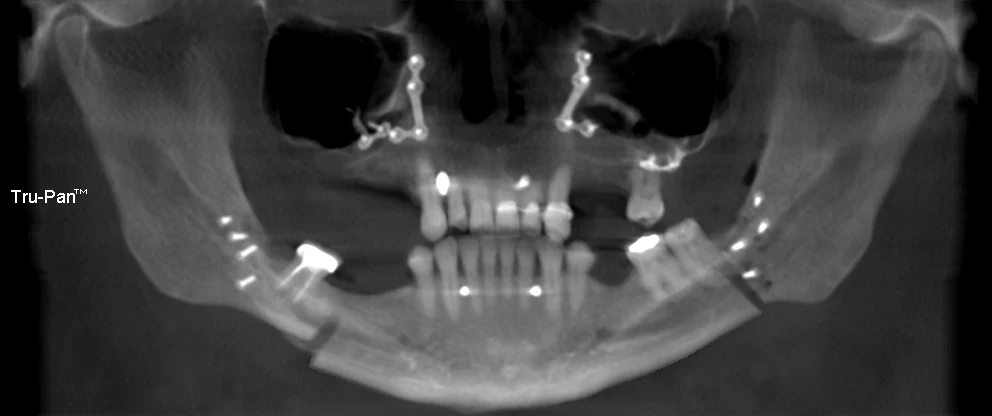
Option 2: A Full-Arch Fixed Prosthesis
Dr. Abernathy also shared an alternative treatment plan for the same patient: “Something called a fixed removable prosthesis; some people call this a hybrid or an All on 4. That would be something that would replace all of the teeth.”
This option is a different approach rather than a quicker equivalent. Instead of one implant per missing tooth, a full-arch prosthesis replaces an entire upper or lower row of teeth with a single prosthetic anchored by dental implants. That’s why full-arch dental implants are often described as a full-mouth dental implant solution.
Because the prosthesis replaces all of the teeth in the arch, the remaining teeth are taken out as part of the procedure. For this patient, Dr. Abernathy described what that would involve:
- “We take the teeth out in one procedure.”
- “You put dental implants at the same time while the patient’s asleep.”
- “We would usually have our prosthodontist do the actual teeth part. He would put in the screwed-in temporaries while the patient’s asleep, so they wake up with a temporary, screwed-in prosthesis that looks like their teeth.”
Those temporaries are just that: temporary teeth, not the finished result. Healing and implant integration take several months, after which the final permanent prosthesis is custom-fitted. Same-day teeth let patients maintain function and confidence during the healing process, but treatment isn’t fully complete on the day of surgery.
Living With a Fixed Prosthesis: Dr. Abernathy’s Trade-In Analogy
Patients who choose the full-arch option often ask what life looks like after the final prosthesis is in place. Dr. Abernathy’s explains, “You can’t get decay, obviously, because they’re metal and acrylic.” The artificial teeth themselves cannot develop cavities.
That doesn’t make the prosthesis maintenance-free. “You can get problems with them that are kind of like problems you can get with natural teeth,” he explains. The goal, he tells patients, is for the implants and the prosthesis to stay in place for life, which is the long-term treatment goal, not a guarantee that the implants or replacement teeth will never need repair or replacement.
To help patients picture the trade-off, Dr. Abernathy uses a car analogy. Think of trading in a high-mileage car that keeps needing major repairs for a new one: “You’re still going to have to do oil changes,” but the aim is to move past the cycle of major repairs that failing teeth require. You must keep up with regular maintenance; daily home care, along with regular professional cleanings and checkups.
Which Option Is Right for You?
The best treatment option depends on your individual needs. The factors Dr. Abernathy considered for this patient are also important to discuss during your consultation:
- How many teeth are missing, and where? The number and location of missing teeth can help determine whether individual implants or a full-arch restoration may be more appropriate.
- How much bone remains? Significant bone loss may require additional bone grafting, which can extend the treatment timeline for individual implants.
- What is the condition of your remaining teeth? A full-arch prosthesis replaces all the teeth in an arch, so evaluating whether your remaining teeth can be preserved is an important part of treatment planning.
- What is your timeline? Treatment timelines vary depending on the number of implants needed, whether bone grafting is required, and the time needed for healing before the final restoration can be placed.
Your oral surgeon will work with you and your referring dentist to evaluate your options and develop a treatment plan. For more complex restorations, patients may also choose to work with our prosthodontist based on their preferences or their dentist’s recommendation.
Considering Dental Implants in Charlotte, NC?
If you’re missing multiple teeth and want to understand which implant option fits your situation, schedule a consultation with Carolinas Center for Oral & Facial Surgery. Our team of surgeons provides dental implants, full-arch dental implants, and full-scope oral surgery for patients throughout Charlotte, Ballantyne, Matthews, Rock Hill, and the greater Charlotte metro area.